|
This month, we had the pleasure of hearing from not just one, but three inspiring leaders from the Association of International Certified Public Accountants (AICPA). Michael Grant, Director of Learning Innovation, Jennier Hackim, Director of Learning Design, and Lizza Igoe, Senior Manager of Learning Design, each shared their unique perspectives. Together, they showcased their incredible work using the LCD model. They discussed the organization’s journey since investing in the LCD practicum. They also explored the exciting new possibilities that have emerged for AICPA.
The AICPA is a global professional association representing over 700,000 accounting professionals. Over the past two years, the organization has experienced tremendous transformation. Instead of focusing on a single shift, AICPA has embraced multiple, interconnected changes. Together, these efforts have propelled the organization toward a bold new future.
What They Changed:
→ Their Scope: From a national US organization to an international organization to reflect the shift in talent as the future of the CPA industry continues to grow in a more global direction. Through acquiring a European association, the AICPA now serves an international membership
→ Their Digital Experience: They launched a hyperpersonalized platform they call RAVE to help their very diverse membership find what they need from the many resources AICPA offers
→ Their Leadership and Org Structure: The previous design of the learning organization has now shifted to three new departments (Content Strategy, Learning Consultant, Learning Design). In some cases, the team included new team members with no L&D experience, even though they may have deep accounting subject matter or customer expertise.
…and *drumroll please*…the LCD model as the strategy and work process to tie it all together.
Learning clusters are the new standard learning experience for AICPA’s membership. Through Michael’s leadership and championship, earlier this year, 60 AICPA learning professionals across all three departments completed the private LCD practicum with flying colors.
This is an organization that doesn’t just have some learning content, but 10,000+ elearning modules and hundreds of webcasts, to modernize and transform into learning clusters for their membership.
In this dialogue, you will hear how they’ve gone about the challenge.
at 6:27 How Michael built the business case with his leaders around adopting the model, including slides from his stakeholder deck.
Critical in this share is how he shared data from AICPA’s own internal surveys of members and the pre-existing desire for learning experiences like what learning clusters offers.
at 15:22 How the organization is structurally aligned with the LCD model.
This is an outstanding example of a modern learning organization design. The leadership took a look at the LCD model and, after the experience of the practicum, were able to align the roles and responsibilities of the three departments with the LCD model Actions.
What AICPA has done represents the future of the LCD model and modern learning organizations. They have moved beyond seeing the LCD model as just another tool in the L&D toolkit. Instead, it now serves as an organizing anchor for the entire organization. Learning clusters and on-the-job behavior change have become their chosen strategic focus. The LCD model guides how the work is planned and executed. Roles and responsibilities are aligned with each Action of the model. This creates consistency, clarity, and collaboration across teams. For those familiar with organization development theory and Galbraith’s STAR model, AICPA is a living example of transforming culture and business through design.
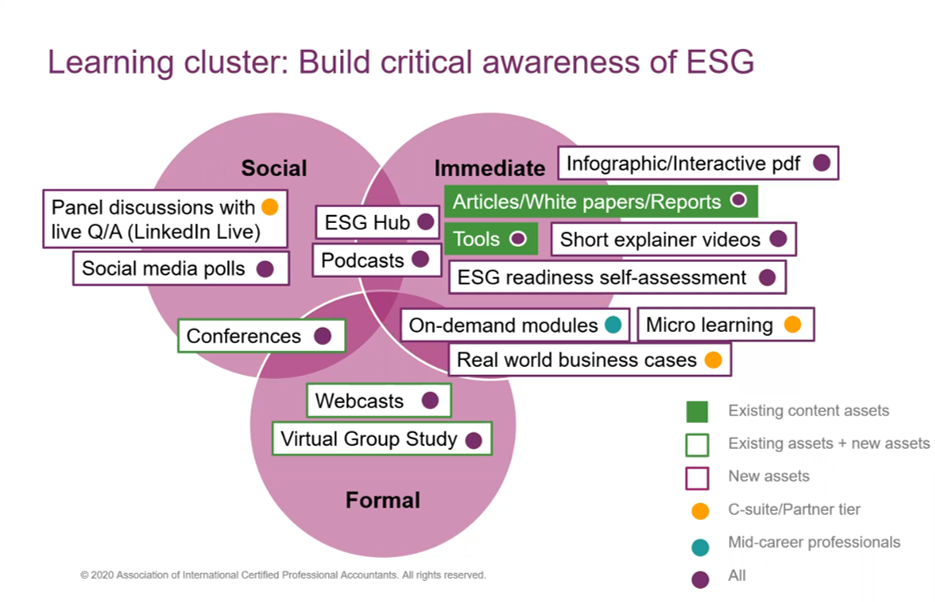
at 18:00 Lizza and Jennifer shared learning clusters AICPA has developed, starting with an Environmental, Social, Governance (ESG) initiative, a brand new topic for accounting professionals.
The examples shared:
→ That Personas are powerful, even when in progress and not “perfect”
→ That it’s important to count learning assets as learning even if they don’t give Continuing Professional Education (CPE) credit, because they deliver learning and make an impact even if unrecognized by the industry
→ That you can overlay other frameworks with LCD model, shared by how in their finished product, they not only organized assets by social, formal, and immediate touchpoints but also by aligning learning assets to a learning “growth” pathway, because it fit better culturally.
at 27:24 We also discussed excellent questions from the community:
- Jinny Kcehowski asks “What was the process to develop personas?”
- Cordes Lindow asks “If some of these learning assets won’t count for credit, how do you work that in?”
- Daniel Caspy “What were the thoughts behind the learning pathway process?”
Catch the full recording below and make sure to register for our next dialogue. |


